Mother Mary, Brave and Bold

Updated: Aug 1
Expecting, waiting, hoping. That's Advent.
That's the Virgin Mary: brave and bold as she is expecting, waiting, and hoping for the fruition of the angel's promise.
Put yourself in the story: Where did she find the faith to overcome her fears?
Where would she find protection?
Where would she find comfort?
Where would she find joy?
Mary as the Rose and the Stem
Where would she find hope?
Put Yourself in the Story
Mary had faith. She expected that what the angel told her would come to pass. She had faith in what was not seen or known. Mary consented to risk her life, to face accusations of adultery, to risk losing her marriage. She was brave and bold to agree to participate in God's plan. She waited. She hoped to deliver God's deliverer.
Pregnant by the Spirit? Claimed the pregnancy was from God? That her son would reign on the throne of David?
I imagine they would have mocked her for being proud, as Joseph's brothers mocked him for his dream of them bowing down to him.
I imagine they would have called her a liar and an adulterer. She put her life at risk by consenting to this pregnancy. Mary was brave and bold.
I imagine Mary's fear when she felt alone, with no one believing her. Even her beloved Joseph did not take her word as true. A woman's testimony was unreliable. He was considering divorce.
I imagine she fled to Elizabeth's house in the country, seeking shelter from both insults and physical harm. Women today often seek shelter with other women when coping with a surprise pregnancy, and the men have not yet stepped up to offer support.
In the first-century Jewish culture, pregnancy and children were always a source of joy. A betrothal was a commitment similar to marriage, and there was no shame for a bride and groom to come together during the betrothal period.
However, the Bible hints that there was a scandal:
Joseph had not yet known Mary, and he considered divorcing her (Matthew 1:18-35). It was his legal right and the only way to retain his honour, since he perceived she had been unfaithful to him.
Others in the community may have known that Joseph and Mary had not come together, leaving room for them to shame or humiliate her. There could have been a scandal that she was pregnant, and not by her betrothed.
While Mary gave her consent to the angel, she may have risked ostracism from her family or community, and felt sad or worried when others doubted her word. Some of her family might have known the pregnancy did not come from her betrothed and suspected it came from adultery. If a woman was caught in adultery, the consequence was being stoned to death.
Mary went "in haste" to her relative, Elizabeth, in the hill country of Judea, a hundred miles away (Luke 1:39). She may have been escaping Nazareth because of her pregnancy. Even today, a young woman with a pregnancy will leave her hometown to avoid shame and scandal, returning after the baby is born. Mary was able to return after the angel appeared to Joseph, and he agreed not to divorce her but to adopt the baby as his own.
The people of Nazareth rejected Jesus as a prophet born of God. They took offence when he presented himself as a teacher, saying he was simply the uneducated son of the carpenter, and they had so little faith that Jesus did few miracles there (Matthew 13:57-58). The people of Nazareth drove Jesus out of town and to the brow of the hill to throw him off (Luke 4:29). Why? Because Jesus said he fulfilled Isaiah's prophecy, a claim that amounted to blasphemy.
Jesus's brothers did not believe in him (John 7:5). They did not see him as the Messiah until after the resurrection (Acts 1:14).
Jesus's enemies hinted that he was an illegitimate child, with an unknown father; the Pharisees said they knew who their father was, but no one knew Jesus's father (John 8:19, 41).
Is it possible that the inexperienced virgin did not know she was pregnant until she was two months along? Is it likely that she was afraid to tell anyone she was pregnant until they actually saw and suspected it? Is it likely that the people of Nazareth believed the young girl's story that the Holy Spirit made her pregnant? Is it possible they thought she was a foolish liar? Is there evidence that Joseph believed Mary? Or did he deny her story until the angel appeared to him?

Where would Mary find Protection?
Joseph's choices were:
(a) proceed with the marriage despite her pregnancy and stand up to anyone who said he was a fool for marrying an unfaithful woman, and adopt Jesus as his son.
(b) Divorce her quietly and retain his honour and be faithful to the law; all those who had been at the Betrothal ceremony would be aware of the divorce, so the quiet divorce would still be publicly known.
(c) Divorce her and testify against her, accusing her of adultery; in the case of adultery, a stoning execution was the consequence, but the witness testifying against the accused was required to cast the first stone. If Joseph opts not to be a witness against Mary, there can be no stoning and no public disgrace (Matthew 1:19).
Before Joseph made his choice, Mary may have been in danger in Nazareth. Mary fled to Elizabeth's place, a relative who lived in the remote hills of Judea, about a hundred miles away. Perhaps she went there because the angel told Mary that Elizabeth had also had a miraculous pregnancy. When she arrived, Mary at last found someone who believed her pregnancy was from God.
Today, we know Joseph chose to and accepted the child as his own, and Jesus became known as the son of Joseph, the carpenter (Matthew 13:54-56, Luke 3:23, 4:22. I imagine the relief when, at last, Joseph said an angel had appeared to him and confirmed Mary's story. After that, he protected her from harm, took her as his wife, and did not know her until after Jesus was born. Joseph joined her in expecting, waiting, and hoping.
Where would Mary find Comfort?
Mary likely arrived at Elizabeth's place after her family and neighbours shamed and humbled her. They may have accused her of adultery and threatened her with divorce and stoning.
Then Elizabeth affirms Mary's testimony that the pregnancy came from God. Finally, Mary is reassured that God has triumphed, and she can sing for joy. Mary's song is like Hannah's song praising God for reversing her fortunes (1 Samuel 2:1-10). It's also a song of victory like Miriam's celebrating victory over the Egyptians (Exodus 15), and like Deborah's song of triumphing over the oppressors (Judges 5). Mary's song praises God for reversing her reputation from one of humiliation to one of honour, for triumphing over her oppressors. Her oppressors were those who were proud in their inmost hearts, those who had shamed and humbled her.
I imagine Elizabeth knew the Scriptures well when she quoted that the one in her womb leaped for joy on seeing Mary pregnant. I imagine Mary knew the Scriptures well and took comfort from the prophet Hannah, who sang about God blessing her with a pregnancy. Mary was learned and devout. She leaned on Scripture and on Elizabeth and Hannah, sisters in faith, and the love of others.
Compare Mary's song of praise to Hannah's:
Mary said | Hannah said |
My soul praises the Lord’s greatness! My spirit finds its joy in God, my Saviour, because he has looked favourably on me, his humble servant. From now on, all people will call me blessed because the Almighty has done great things for me. His name is holy. | My heart finds joy in the Lord. My head is lifted to the Lord. My mouth mocks my enemies. I rejoice because you saved me. There is no one holy like the Lord. |
For those who fear him, his mercy lasts throughout every generation. He displayed his mighty power. He scattered those who think too highly of themselves. He pulled strong rulers from their thrones. He honoured humble people. He fed hungry people with good food. He sent rich people away with nothing. | Do not boast or let arrogance come out of your mouth because the Lord is a God of knowledge, and he weighs our actions. The bows of the warriors are broken, but those who stumble are armed with strength. Those who were well-fed hire themselves out for a piece of bread, but those who were hungry hunger no more. |
He remembered to help his servant Israel forever. This is the promise he made to our ancestors, to Abraham and his descendants. Luke 1:46-55 GW | The Lord causes poverty and grants wealth. He humbles people; he also promotes them. He raises the poor from the dust. He lifts the needy from the trash heap in order to make them sit with nobles and even to make them inherit a glorious throne.… He safeguards the steps of his faithful ones… Excerpts from 1 Samuel 2:1-9 GW |

Where would Mary find Joy?
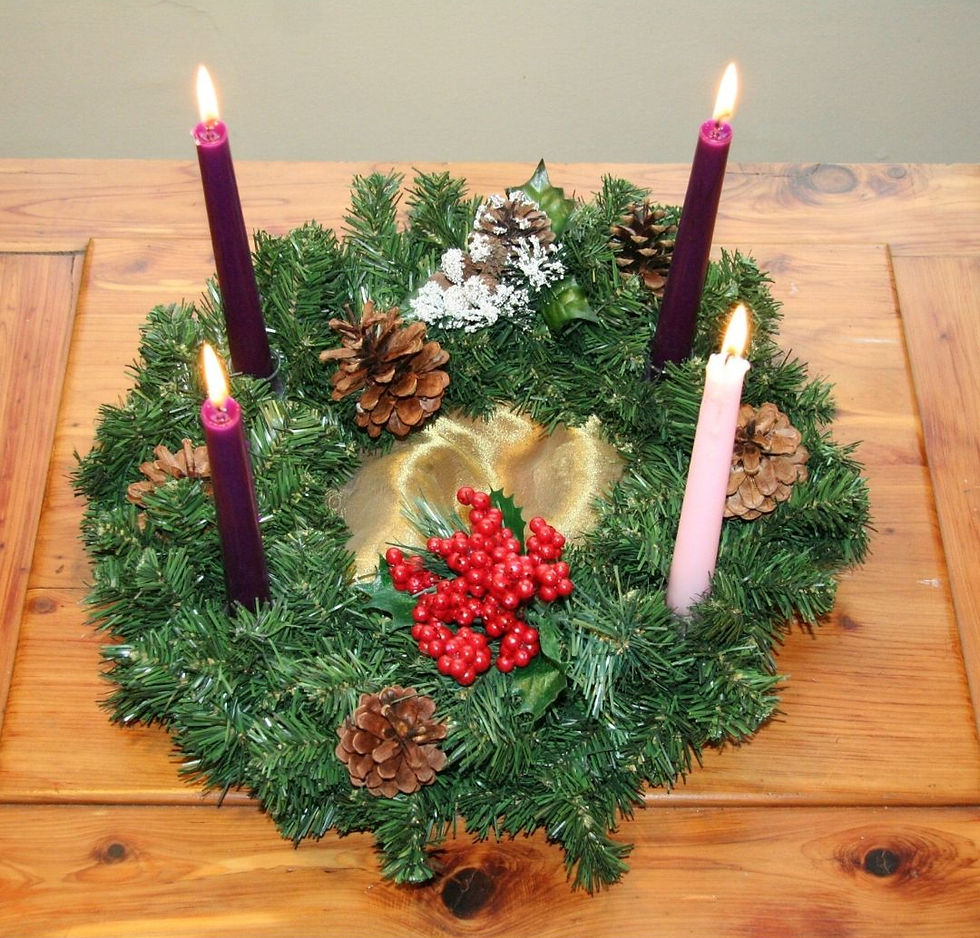
The colour of Advent is purple, representing a time of penance and self-reflection, when we prepare for the arrival of the Christ-child. But the colour of the 3rd Sunday of Advent is rose-pink, representing joy.
After Mary arrived safely at Elizabeth's house, and Elizabeth affirmed Mary's holy pregnancy, Mary sang joyfully about expecting a child who would reverse power structures, uplift the lowly, pull down the powerful, feed the poor, and send the rich away hungry.
After Jesus was born, Mary and Joseph took Jesus to the Temple, where Simeon prophesied a reversal of fortunes that is very similar to that prophesied by Mary's song:
"This child is destined for the falling and the rising of many in Israel and to be a sign that will be opposed so that the inner thoughts of many will be revealed—and a sword will pierce your own soul, too. (Luke 2:34-35 NRSVUE).
Part of that great reversal of power structures is the way God uplifts women, giving them the same authority as men. Anna is named as a prophet who teaches men and women in the Temple:
"At that moment, she came and began to praise God and to speak about the child to all who were looking for the redemption of Jerusalem (Luke 2:38 NRSVUE).
Mary's joy came from knowing God would lift her out of humiliation and all generations would call her blessed. Mary would continue to wait for these prophecies to come true through Jesus's ministry. With Mary and her song of praise, we celebrate the arrival of the Messiah-deliverer for all humanity with joyful expectation.
Mary's Reassurance: The Mystic Rose and the Stem of Jesse's Stump

Throughout church history, Mother Mary has been called the Mystic Rose. She is represented in art, stained glass windows, statues, and mosaics with roses. The 13th-century Chartres Cathedral shows Mary in stained-glass windows and statues. She is also represented by the six-petaled rose at the centre of the labyrinth on the Cathedral's floor. Pilgrims walk the path to the centre, seeking wisdom and guidance, the way to God, to reconciliation, and to unity between body and soul.
Where does the idea of Mary as the Rose originate? From earliest times, Mother Mary was associated with the woman (or bride) speaking to her lover (or groom) in the Song of Solomon:
I am the rose of Sharon, and the lily of the valleys... He brought me to the banqueting house, And his banner over me was love. (Song of Solomon 2:1, 4 NKJV)
Mary is the rose, and God brings Mary to the great banquet and shows the world his love for her. Seeing this imagery shows Mary as the first to belong to what we call the church, the organization which is the metaphoric bride of Christ; he is no longer acting as Mary's son, but as the Messiah. She leads the church to the way to be Christ's bride and join God's banquet. The Mystic Rose is God's plan to bring Jesus to us.
Protestant Reformers were concerned that Mary would be elevated too much, on par with Jesus, our redeemer. Protestants opposed depictions of Mary as devout and faithful, the God-bearer, an intercessor, or any other priest or pastor who may pray for their congregation. But Mary told Jesus it was time to do his first public miracle (John 2), and Mary followed him to the foot of the cross. In following Mary, we may come to know Jesus more. Just as Mary offered Jesus to the world at his birth, her story can lead people to Jesus today.
Perhaps Protestants thought that calling Mary the Mystic Rose was giving her too much reverence. They see Jesus playing the part of the woman in Song of Solomon 2, with Jesus as the Rose of Sharon and the Lily of the Valley. Artwork shows Mary holding a rose on her lap in place of baby Jesus, with Jesus being called the Rose that blossoms. Christian hymns refer to Jesus as the Rose:
"People, Look East and sing today: Love, the Rose, is on the way" - 1928 Advent hymn
"Lo, how a Rose ever blooming from tender stem hath spring. Of Jesse's lineage coming, as those of old have sung." - A 15th-century Advent hymn
Where did Christians get the idea that Jesus is a Rose or a Lily, not Mary?
The wilderness and the wasteland shall be glad for them, And the desert shall rejoice and blossom as the rose (Isaiah 35:1 NKJV).
The Messiah must come from David's line, for Isaiah's prophecy says the Messiah will be a shoot or twig from David's father, Jesse. Christians may understand that Jesus is the shoot (rod/twig/stem) that grows from the dead stump of Jesse, since Jesse was David's father, and Jesus is in David's line.
However, it is also true that Mary is in David's line, and Mary may be the stem, shoot, or twig that grows from the stump of Jesse, and on Mary's stem is the bloom of the Rose, Jesus.
Genealogies in Matthew and Luke both point back to David's line. Let's compare the two genealogies in the Gospels:
Matthew 1:1-17 | Luke 3:23-38 |
Joseph, Jesus's legal father (step-father) | Joseph, the supposed father of Jesus |
Joseph's father is Jacob. From the deportation to Babylon to the birth of Jesus, there are fourteen generations (Matthew 1:12-17). | Joseph's father-in-law is Heli (Mary's father). This genealogy is considered Mary's, even though only men are named. There are about 39 generations from Heli to Nathan. |
David, father of Solomon by Bathsheba, following Solomon's line from David to the deportation to Babylon, fourteen generations (Matthew 1:6-11). | David, father of Nathan by Bathsheba (Luke 3:31, 1 Chronicles 3:5). |
Abraham, father of Isaac, Jacob, Judah, the father of Perez and Zerah by Tamar, down the line to Salmon and Rahab, parents of Boaz, Ruth and Boaz, parents of Obed, father of Jesse, father of King David. From Abraham to David, there were fourteen generations (Matthew 1:1-6). | Abraham, father of Isaac, father of Jacob, father of Judah. Judah and Tamar were parents of Perez, and down the line to Boaz and Ruth, then Obed, then Jesse, the father of King David (Luke 3:31-34). |
This genealogy goes from Christ through David to Abraham. | Before Abraham, there are ten generations to Shem, the son of Noah, and the lineage goes back to Seth, the son of Adam, the son of God (Luke 3:34-38). |
Matthew's target audience is Jews. The focus is on the legal genealogy. Showing Jesus in the line of King David and King Solomon gives Jesus a legal claim to be King of the Jews. | Luke's target audience is Gentiles. The focus is on the bloodline. Showing Jesus as the Son of God gives Jesus a claim to the priestly throne of the Messiah and shows that Jesus is the saviour for all people, Jews and Gentiles. |
Where would Mary find Hope?
Mary's hope was fulfilled in Jesus. Mary encouraged Jesus to perform his first public miracle, at a family wedding in Cana, validating her testimony. Perhaps, at last, they would believe her account that her son was a child of God. Perhaps, at last, they would see that Jesus was fulfilling the prophecies.
I imagine that Mary knew Isaiah's prophecy that the Messiah-deliverer would come from her own lineage, the line of Jesse.
Then a Shoot (the Messiah) will spring from the stock of Jesse [David’s father], And a Branch from his roots will bear fruit. t (Isaiah 11:1 AMP)
The Hebrew word translated as "shoot" is also translated as twig, stem, or rod. The stump of Jesse may have appeared dead. Then a shoot came up from Jesse, a tender stem that appears to be Mary. She bears the blossom of Jesus. Jesus is the Root and Blossom of Jesse's stump (Revelation 22:16), but let us not forget Mary's part in the line of Jesse.
In 2025, I walked beside the stump of the Sycamore Gap tree, which was cut down in 2023 by an act of vandalism (yes, they have been sentenced for their crime). This 200-year-old tree was beloved by all, a special spot for photographs and marriage proposals, and featured in the movie Robin Hood: Prince of Thieves. In 2016, it was crowned as the English Tree of the Year in the Woodland Trust's awards. People mourned the act of vandalism and placed pieces of it in a nearby gift shop, arranged as a shelter of hope, a resting place for an old friend, bringing people closer together in sadness.

I was moved to tears when I saw the stump of the Sycamore Gap tree in northern England. The stump appeared dead. But now, two years later, the tree stump is sprouting. New shoots are springing up from the stump. It is still heartbreaking to lose an old friend, but there is hope. New life is beginning.
God chose a woman to bring Jesus into the world, and Jesus taught women as his students and commissioned women to tell men about him. Jesus brought the great reversal that was prophesied by Mary and Simeon and demonstrated by women in the New Testament. The Bible endorses gender equality. There is hope.

Conclusion
We are expecting, waiting, and hoping during the Advent season. We can put ourselves in the story, imagine it in order to contemplate Scripture and understand God's word. Mary may have faced scorn and rejection, but she moved forward, brave and bold:
Mary may have found protection when Joseph believed the angel and took Mary as his wife.
Mary would have found comfort in escaping to Elizabeth's home in the hills, and hearing Elizabeth acknowledge that Mary's pregnancy was God-given.
Mary sang a song of joy and victory, mirroring the song of Hannah. She sang about the great reversal of power structures and how God would lift her out of humiliation to a place of honour. We can share Mary's joy that God lifts us from being shamed and marginalized to a place where we are respected and valued.
We can share Mary's reassurance that Jesus fulfilled Isaiah's prophecies of a rose blooming from the stump of Jesse, from David's line. Mary is in the line of David and Jesse, and she may be the stem, shoot, twig, or rose that grows from the stump of Jesse.
We can share in Mary's hope that Jesus fulfilled the prophecies and is the promised deliverer, that Jesus crushed the Deceiver and established God's reign on earth.
Mary's waiting is finished. Jesus delivered God's word to us. Now God expects, waits, and hopes for God's people to share God's new commandment, to love one another.
We can proclaim the mystery of our faith: Christ has died, Christ is risen, Christ will come again in glory.
Elaine Ricker Kelly, Author, is empowering women with historical fiction about women in the Bible and early church, and Christian blogs about women in leadership, church history and doctrine. Her books include:
Forgotten Followers from Broken to Bold, Book 1, A Novel (2022). Forgotten Followers retells the Gospels from the women's viewpoint. Encounter Mary, bravely following Jesus, though she knows the prophecies. Meet Mara (Mary of Clopas), healing from trauma and silenced by sexism. Walk with the female patrons and disciples Joanna, grappling with racism, Mary Magdalene, and Susannah.
The Sword: A Fun Way to Engage in Healthy Debate on What the Bible Says About a Woman's Role (2023)
Because She Was Called from Broken to Bold, Book 2, A Novel of the Early Church (2024). Set in Acts 2-11, this novel shows women testifying before men, and the early church baptizing all who hear the word.
Walk with Mara on Her Healing Journey: 21 Steps to Emotional Resilience (2024)
Finding Her Voice from Broken to Bold, Book 3, Acts of Early Female Apostles: A Novel (2025). Set in Acts 11-15, this novel has themes of breaking the division between Jews and Gentiles, citizens and slaves, men and women.


Comments